- Diagnostic guide
- Range Repair
Why One Burner Clicks and Will Not Light
- Filed
- Reading
- 4 minutes
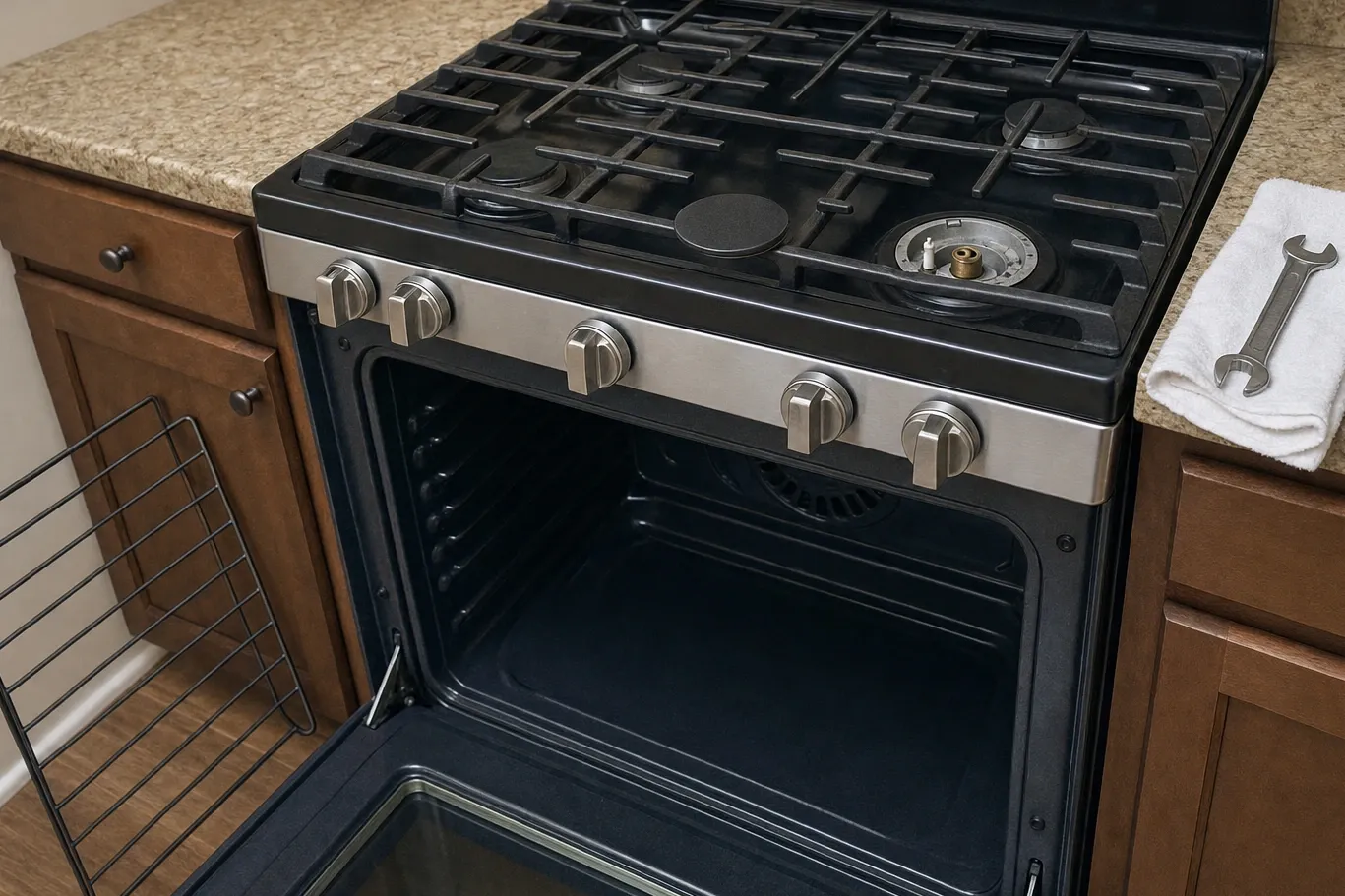
A burner that sparks and sparks without catching turns up on the phone more often than anything else on a range, and it gets misread more often than anything else too. The instinct is to blame the spark module, because clicking is the thing you can hear. In practice that module is usually fine — it is making a spark, which is precisely why you can hear it — and what has actually gone wrong is that spark and fuel are arriving in different places.
There are four things that produce this symptom on a sealed-burner range, and three of them you can check yourself in the time it takes the kettle to boil.
Start with the cap, because it is usually the cap
Lift the burner cap off. It should drop back onto the burner base and sit dead flat, with no rocking and no gap anywhere around its rim. If it rocks, or if it sits proud on one edge, the gas leaving the ports is being deflected away from the electrode and the spark has nothing to ignite.
This happens far more often than it should because caps get moved. They come off for cleaning, they get put back on the wrong burner — the caps on a five-burner range are frequently not interchangeable, even when they look it — or they get knocked out of position by a heavy pan being dragged across the grates. On a range where somebody has recently cleaned the cooktop, this is the first thing to check and it is right about half the time.
While the cap is off, look at the burner base underneath. You are looking for the ring of small ports around its edge and, sitting beside them, the ceramic-sleeved electrode that produces the spark. Both need to be clean and dry.
Blocked ports and what actually blocks them
Ports block from the inside out. A boil-over runs down into the burner, dries, and leaves a deposit that narrows the ports nearest the spill. The burner then lights unevenly — a section of the ring catches and the rest stays dark — or it does not catch at all, because the ports closest to the electrode are the blocked ones.
The fix is mechanical and it is not a chemical one. A stiff brush and a straightened paperclip through each port clears it. What does not work is spraying cleaner into the burner, which mostly relocates the deposit further in and leaves you with a burner that lights badly in a new pattern.
Two things to avoid here. Do not use a wooden toothpick, because they snap off in the port and then you have a repair rather than a cleaning job. And do not enlarge a port with a drill bit — the port size sets the gas-to-air mixture, and a burner with one oversized port burns lopsided forever.
A wet electrode after a spill
If the range has boiled over recently, or the cooktop has just been washed, the ceramic sleeve around the electrode may simply be damp. A damp sleeve lets the spark track down the ceramic to the burner body instead of jumping the gap to the burner cap, and you get the click without the ignition.
The test is patience: leave the burner alone, cap off, for a couple of hours. If it lights after that, you had a wet electrode and nothing is broken. If it still will not light dry, the ceramic may be cracked, and a cracked sleeve does the same thing permanently. That one is a part, not a cleaning.
What is left, and why it needs a gauge
If the cap is right, the ports are clear and the electrode is dry and undamaged, you are down to the gas side, and this is where a householder’s checks end.
The candidates are a valve that is not opening fully, an orifice sized for the wrong gas, and manifold pressure that is too low to sustain ignition. Each is measured rather than inspected. The gauge goes on the manifold, the pressure is read with the burner calling for gas — not at rest, which is the reading that misleads people — and the orifice is checked against what the range is actually plumbed for.
That last one matters more than it sounds on this housing stock. A range converted from natural gas to propane, or moved between properties during a rehab, sometimes arrives with the wrong orifice set fitted or with a conversion done halfway. The symptom is exactly what you are looking at: a burner that sparks properly, gets gas, and will not establish a stable flame.
When to stop and call
Three points, and none of them are close calls.
If you can smell gas at any time other than during a lighting attempt, stop, turn off the range and open a window. That is not a diagnostic exercise.
If the burner lights and then goes out on its own after a few seconds, the flame sensing circuit is shutting the valve because it cannot confirm a flame. That is a safety device doing its job and it should not be worked around.
And if you have cleaned the cap and the ports, dried the electrode and the burner still will not catch, every remaining answer needs a gauge on the manifold. What you are paying for at that point is a measurement rather than an opinion: $89 buys the visit plus a complete diagnosis, and comes straight back off the repair should you decide to go ahead with it.
Questions that follow this one
-
Is it safe to keep pressing the igniter?
No, and this is the one place we would be firm about it. The gas valve is open the whole time the burner is clicking, so every failed attempt puts unburned gas into the room. Turn the knob off, give it a few minutes with a window open, and try once more. If it does not catch on that attempt, leave it off and work through the checks below with the gas at the knob shut.
-
Every burner clicks when I turn on just one. Is that a fault?
It is normal on most sealed-burner ranges. One spark module fires all of the electrodes at once, so lighting the front left makes the rest of them tick too. What is not normal is the clicking continuing after the burner has lit, which usually means a switch or an electrode is staying wet or dirty enough to keep the module triggered.
-
The burner lights but the flame is orange and lazy. Same problem?
Different problem, and worth a separate look. Orange or yellow tips mean the flame is not getting the air it needs, which is usually a blocked port, a cap out of position, or a range starved of make-up air by a hood pulling harder than the kitchen can replace. A blue flame with defined cones is what you are aiming for.
-
Does cold weather really affect this?
It affects the margins rather than causing the fault. On the coldest mornings, when most of the block is calling for heat at once, gas pressure at the meter sits at its lowest of the year. A burner with a partly blocked port will light fine in October and refuse in January, and nothing about the appliance changed in between.